French Drain, What you need to know!
What you need to know about French Drains
French drains (FDs) are a solution employed to get rid of standing water in your yard or basement. Basically they consist of a trench that is covered with rock or gravel. The trench serves to capture the groundwater and direct it away from the home. They may also utilize pipes which are perforated to vent the water that comes through the gravel into the drain. The most common use for FDs is to redistribute water that sits up against a home’s foundation which would otherwise cause structural damage.
Where Did the Idea for French Drains Come from?
One of the benefits of choosing to go with FDs is the fact that they have been used for a really long time. That means you can rely on this technique to solve your drainage problems when it is properly planned and installed. Originally they were basically just simple ditches. But in the 1800s, FDs were made popular by a lawyer named Henry French, hence the title “French drains.” His version of the FD comprised roofing tiles in the trenches to allow for drainage. These roofing tiles later gave way to special perforated tiles.

Different Types of French Drains
Plenty of variations of the French drain exist. Here are just a few of them:
Dispersal drain-Used for septic tanks to properly distribute the waste water. Filter drain-This type drains ground water. Drain buried around foundation-As discussed above, this sort of FD is probably the most popular and is used to take water away from the structure to keep it safe from harm. Basement floor drains-Sometimes the drains are actually installed inside the basement to make sure any water that comes in finds its way back outside quickly.
Of course there are other sorts of drains out there, but the above tend to be the most common.
Finding a Company to Install French Drains for You
If you have drainage issues in your home or place of business, then you are likely in need of the French drain solution. First and foremost, it is highly recommended that you do not try to install your own FD. Not only is it a lot of work, but imagine doing all the work only to find out that your drainage system does not function properly. With that in mind, it is best to hire a company that specializes in drainage solutions for homes and businesses.
Building basement French drains
French drains are very popular in basements and are used for a long time to arrange lots of water tables. The French drains collect water and then diverted to a sump pump that pumps the water out of the basement.
How a French Drain Works
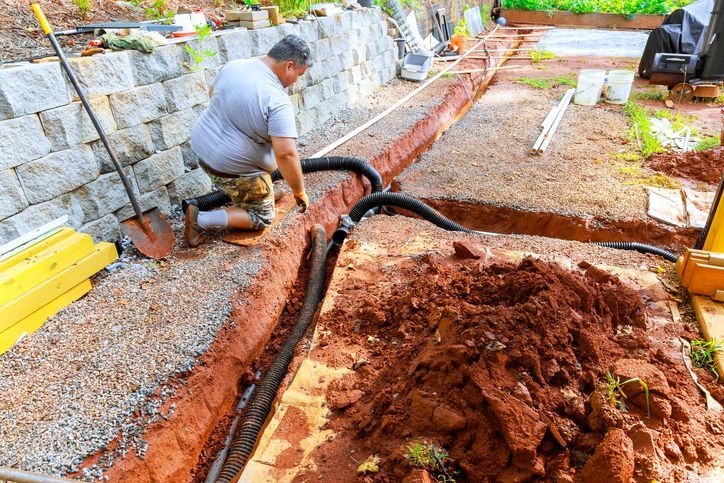
French drains provide an easy channel for water to flow through. Water runs into a gravel-filled trench, then into perforated pipe at the bottom of the trench.
Water travels freely through the pipe, which empties a safe distance from the house.
The trench bottom should be sloped about 1 inch for every 8 feet in the direction you want water to flow. Depending on your situation, the water can be diverted to.
Here are a few tips on how to install a French drain in your basement:
- You will need to dig a trench with a width of 14 centimeters and a depth of 8.
- You need to do this around the entire perimeter of the basement.
- You need to use a jackhammer and pay close attention to this operation as you can damage the walls of the basement.
- Next remove the debris that you created from the graves.
- Place a layer of fine gravel in the trench. It should be two inches in height.
- When the perforated pipe was on the top of the gravel. Start sites of the pipes from the sump pump.
- Use pipe couplings to attach the tubes to each other.
- Now completely cover the pipe with gravel, until you reach the level of the basement floor.
French drains are perfect solutions for diverting water from your home and into sewers or other drainage systems. French drains can be internal or external also there may be times that after abundant rain, you are experiencing drainage problems. French drains drain pipes installed in the ground, will definitely help you to better drain your garden.

Author: Jay Nagy
Owner & Founded of J Bird's Landscaping. 18+ Years of experience in Pittsburgh lawn cutting, patio installation, trucking/hauling, French drain installation, and other landscape/design services.
More Posts from J Bird's Landscaping